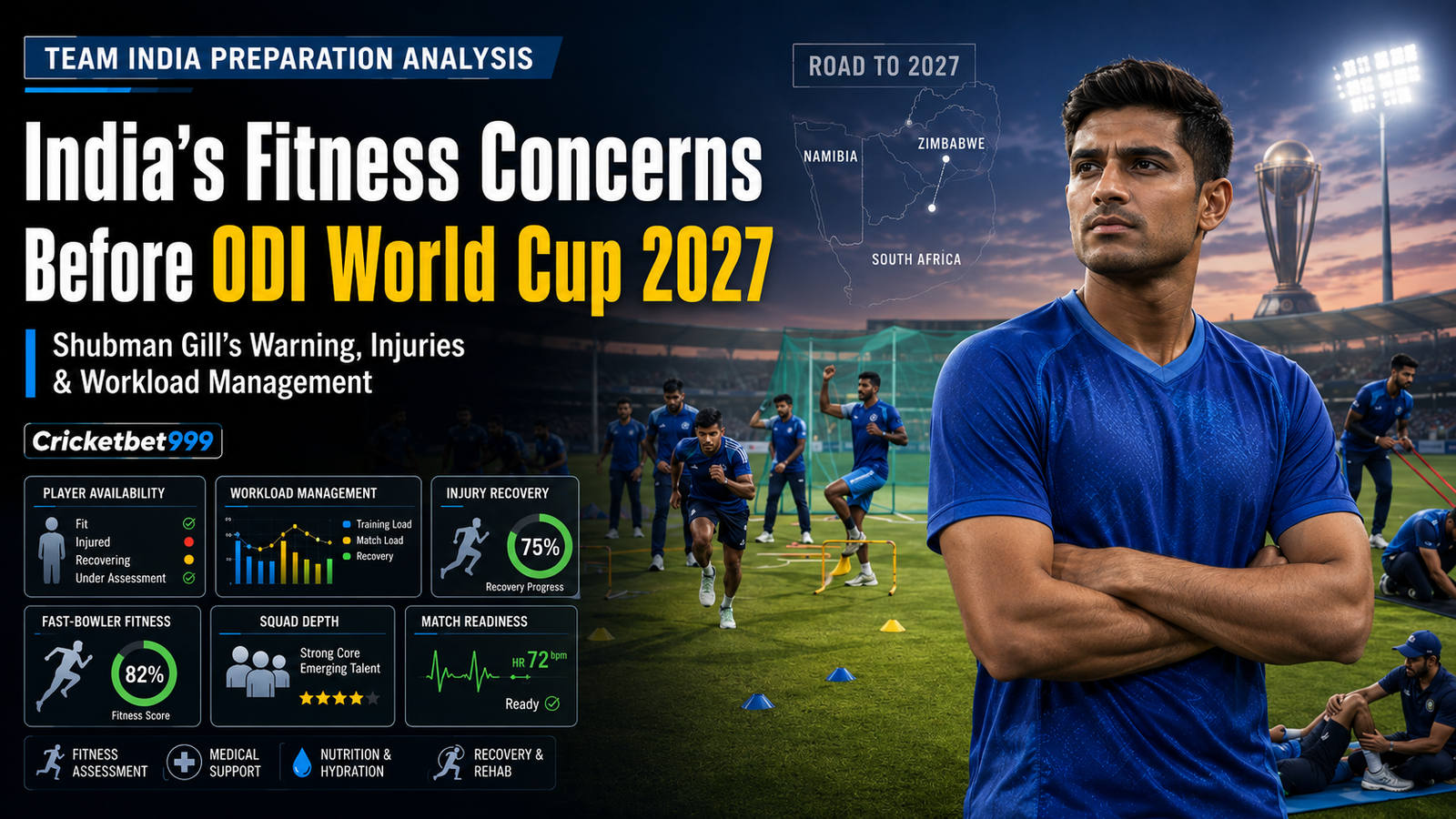
Team preparation for the 2027 ODI World Cup involves far more than form and tactics. Fitness, recovery and player availability are equally important. The debate became more serious after captain Shubman Gill observed that several absences had prevented India from selecting their preferred team throughout the ODI series in England. India eventually lost the series 2–1 to England following the final ODI at Lord’s on 19 July 2026. Therefore, India fitness concerns before ODI World Cup 2027 include injuries, workload management, suitable replacements and the need to preserve team cohesion. India Fitness Concerns Before ODI World Cup 2027: Key Takeaway Frequent injuries force India to make regular changes to their playing XI. These changes affect the pace-bowling unit, batting depth, all-rounder balance and continuity in the field. Before the World Cup, India need their first-choice players to remain available for longer periods. The team must also implement effective recovery strategies and identify competent backup players for every important role. Why India’s Fitness Problems Have Sparked a Conversation The issue took centre stage after India’s ODI series in England. Shubman Gill acknowledged that almost five key players were unavailable for the final match compared with the playing XI that India had initially planned. Hardik Pandya remained unavailable while building his workload for 50-over cricket. Nitish Kumar Reddy missed the tour because of an injury. Jasprit Bumrah did not play the final ODI because of a reported knee issue, while Harshit Rana and Washington Sundar suffered hamstring injuries during the series. Such disruption makes team management more challenging. For example, the absence of a frontline pace bowler can significantly affect powerplay and death-over strategies. Similarly, the absence of an all-rounder may reduce batting depth or limit bowling versatility. What Did Shubman Gill Say About India’s Fitness? Captain Shubman Gill addressed the issue after India’s defeat in the third ODI at Lord’s on 19 July 2026. He explained that repeated injuries had prevented India from selecting their preferred playing XI throughout the tour. Gill also indicated that India would need to improve player fitness and availability over longer periods to compete effectively during the demanding 2027 World Cup campaign. Although a team can usually manage one injury, repeated disruptions can weaken tactical planning and prevent players from settling into clearly defined roles. Therefore, the central message behind the Shubman Gill fitness warning was the need for greater continuity and player availability across an entire series. Confirmed Injury and Availability Concerns Player Reported issue or status Effect on team combination Current confirmation Hardik Pandya Unavailable while building 50-over fitness Reduced pace-bowling all-rounder balance Reputable reporting; no return date assumed Nitish Kumar Reddy Left quadriceps discomfort Removed an all-round option Confirmed by BCCI on 23 June 2026 Harshit Rana Grade 1 right hamstring injury Reduced pace-bowling depth Confirmed by BCCI on 12 July 2026 Washington Sundar Right hamstring injury Reduced spin and lower-order batting depth Confirmed by BCCI on 18 July 2026 Jasprit Bumrah Missed the decider with a reported knee issue Reduced new-ball and death-over experience Absence confirmed at the toss; further update awaited The BCCI confirmed that Nitish Kumar Reddy required rehabilitation after reporting discomfort in his left quadriceps. It later confirmed hamstring injuries involving Harshit Rana and Washington Sundar. Meanwhile, Jasprit Bumrah’s absence from the deciding ODI at Lord’s was confirmed at the toss. Hardik Pandya was also reported to be following a programme designed to build the fitness and workload required for 50-over cricket. However, readers should treat these details as current availability updates rather than definite World Cup forecasts. Medical assessments, recovery progress and team-selection information may change. How Injuries Affect India’s Team Combination Pace-Bowling Combination The absence of a frontline strike bowler can weaken India’s control during the powerplay and death overs. Replacement bowlers may perform well. However, the team must integrate them into the setup and give them clearly defined roles before they enter high-pressure situations. A new-ball bowler, middle-overs enforcer and death-over specialist may require different skills. Consequently, losing one experienced bowler can force India to adjust several phases of their bowling plan. All-Rounder Balance A pace-bowling all-rounder allows India to include an additional specialist batter or bowler in the playing XI. Without that option, the management may have to choose between batting strength and bowling variety. As a result, the absence of one all-rounder can affect the entire structure of the team. India must therefore prepare alternative combinations that can maintain balance even when a first-choice all-rounder remains unavailable. Batting Order Stability Injuries often force teams to reshuffle their batting order. They can also change the roles of middle-order batters and finishers. When players regularly move between positions, partnerships may take longer to develop. Batters may also enter the game in unfamiliar match situations. A stable batting order helps players understand when to attack, when to rebuild and how to manage pressure during difficult phases. Fielding and Fitness Standards Player fitness directly affects running between the wickets, boundary coverage and catching under pressure. It also influences how effectively players maintain intensity throughout a long ODI innings. Fatigue may reduce reaction speed, movement and decision-making during the later stages of a match. Therefore, fitness is not limited to avoiding injuries. It also supports consistent fielding standards and faster recovery between matches. Workload Management Before the 2027 ODI World Cup Effective workload management means finding the right balance between playing, training and recovering. Players participate in different international formats, domestic competitions, franchise cricket and demanding travel schedules. Consequently, the management must monitor both match workload and recovery time. Fast bowlers face particular challenges because repeated bowling spells place significant physical demands on the body. However, necessary rest should not be confused with injury. Planned rotation can protect players and keep them available for major tournaments. On the other hand, poorly timed rest may leave a player short of match practice. The main objective should be to optimise preparation, support recovery and gradually build the fitness and stamina required for ODI cricket. Players India Need to Manage Carefully