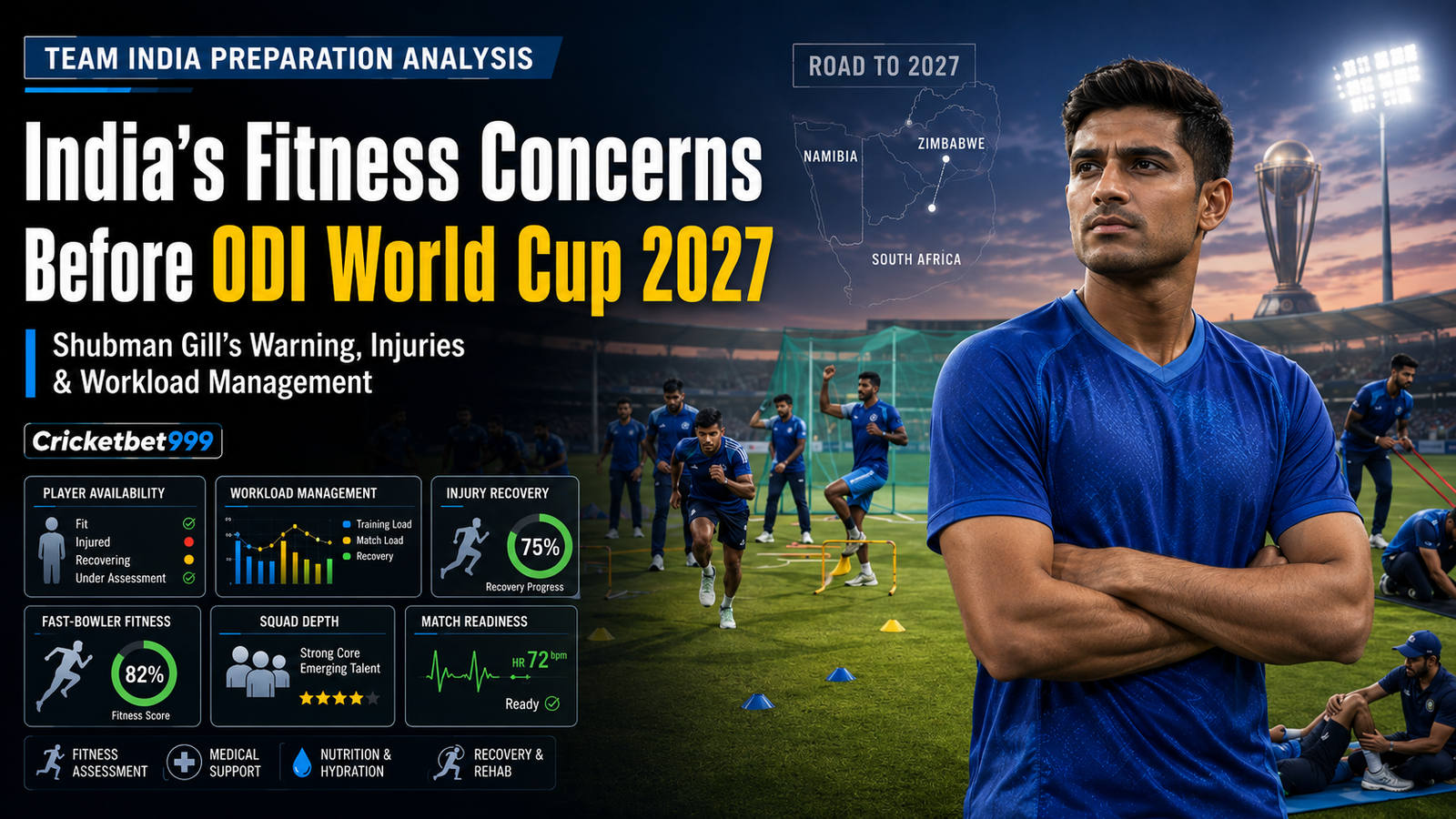
Team preparation for the 2027 ODI World Cup involves far more than form and tactics. Fitness, recovery and player availability are equally important.
The debate became more serious after captain Shubman Gill observed that several absences had prevented India from selecting their preferred team throughout the ODI series in England.
India eventually lost the series 2–1 to England following the final ODI at Lord’s on 19 July 2026. Therefore, India fitness concerns before ODI World Cup 2027 include injuries, workload management, suitable replacements and the need to preserve team cohesion.
India Fitness Concerns Before ODI World Cup 2027: Key Takeaway
Frequent injuries force India to make regular changes to their playing XI. These changes affect the pace-bowling unit, batting depth, all-rounder balance and continuity in the field.
Before the World Cup, India need their first-choice players to remain available for longer periods. The team must also implement effective recovery strategies and identify competent backup players for every important role.
Why India’s Fitness Problems Have Sparked a Conversation
The issue took centre stage after India’s ODI series in England.
Shubman Gill acknowledged that almost five key players were unavailable for the final match compared with the playing XI that India had initially planned.
Hardik Pandya remained unavailable while building his workload for 50-over cricket. Nitish Kumar Reddy missed the tour because of an injury. Jasprit Bumrah did not play the final ODI because of a reported knee issue, while Harshit Rana and Washington Sundar suffered hamstring injuries during the series.
Such disruption makes team management more challenging. For example, the absence of a frontline pace bowler can significantly affect powerplay and death-over strategies. Similarly, the absence of an all-rounder may reduce batting depth or limit bowling versatility.
What Did Shubman Gill Say About India’s Fitness?
Captain Shubman Gill addressed the issue after India’s defeat in the third ODI at Lord’s on 19 July 2026.
He explained that repeated injuries had prevented India from selecting their preferred playing XI throughout the tour. Gill also indicated that India would need to improve player fitness and availability over longer periods to compete effectively during the demanding 2027 World Cup campaign.
Although a team can usually manage one injury, repeated disruptions can weaken tactical planning and prevent players from settling into clearly defined roles.
Therefore, the central message behind the Shubman Gill fitness warning was the need for greater continuity and player availability across an entire series.
Confirmed Injury and Availability Concerns
| Player | Reported issue or status | Effect on team combination | Current confirmation |
| Hardik Pandya | Unavailable while building 50-over fitness | Reduced pace-bowling all-rounder balance | Reputable reporting; no return date assumed |
| Nitish Kumar Reddy | Left quadriceps discomfort | Removed an all-round option | Confirmed by BCCI on 23 June 2026 |
| Harshit Rana | Grade 1 right hamstring injury | Reduced pace-bowling depth | Confirmed by BCCI on 12 July 2026 |
| Washington Sundar | Right hamstring injury | Reduced spin and lower-order batting depth | Confirmed by BCCI on 18 July 2026 |
| Jasprit Bumrah | Missed the decider with a reported knee issue | Reduced new-ball and death-over experience | Absence confirmed at the toss; further update awaited |
The BCCI confirmed that Nitish Kumar Reddy required rehabilitation after reporting discomfort in his left quadriceps. It later confirmed hamstring injuries involving Harshit Rana and Washington Sundar.
Meanwhile, Jasprit Bumrah’s absence from the deciding ODI at Lord’s was confirmed at the toss. Hardik Pandya was also reported to be following a programme designed to build the fitness and workload required for 50-over cricket.
However, readers should treat these details as current availability updates rather than definite World Cup forecasts. Medical assessments, recovery progress and team-selection information may change.
How Injuries Affect India’s Team Combination
Pace-Bowling Combination
The absence of a frontline strike bowler can weaken India’s control during the powerplay and death overs.
Replacement bowlers may perform well. However, the team must integrate them into the setup and give them clearly defined roles before they enter high-pressure situations.
A new-ball bowler, middle-overs enforcer and death-over specialist may require different skills. Consequently, losing one experienced bowler can force India to adjust several phases of their bowling plan.
All-Rounder Balance
A pace-bowling all-rounder allows India to include an additional specialist batter or bowler in the playing XI.
Without that option, the management may have to choose between batting strength and bowling variety. As a result, the absence of one all-rounder can affect the entire structure of the team.
India must therefore prepare alternative combinations that can maintain balance even when a first-choice all-rounder remains unavailable.
Batting Order Stability
Injuries often force teams to reshuffle their batting order. They can also change the roles of middle-order batters and finishers.
When players regularly move between positions, partnerships may take longer to develop. Batters may also enter the game in unfamiliar match situations.
A stable batting order helps players understand when to attack, when to rebuild and how to manage pressure during difficult phases.
Fielding and Fitness Standards
Player fitness directly affects running between the wickets, boundary coverage and catching under pressure.
It also influences how effectively players maintain intensity throughout a long ODI innings. Fatigue may reduce reaction speed, movement and decision-making during the later stages of a match.
Therefore, fitness is not limited to avoiding injuries. It also supports consistent fielding standards and faster recovery between matches.
Workload Management Before the 2027 ODI World Cup
Effective workload management means finding the right balance between playing, training and recovering.
Players participate in different international formats, domestic competitions, franchise cricket and demanding travel schedules. Consequently, the management must monitor both match workload and recovery time.
Fast bowlers face particular challenges because repeated bowling spells place significant physical demands on the body.
However, necessary rest should not be confused with injury. Planned rotation can protect players and keep them available for major tournaments. On the other hand, poorly timed rest may leave a player short of match practice.
The main objective should be to optimise preparation, support recovery and gradually build the fitness and stamina required for ODI cricket.
Players India Need to Manage Carefully
India should pay close attention to senior fast bowlers, pace-bowling all-rounders and players returning from injuries.
Multi-format batters and wicketkeeper-batters also face considerable physical and mental pressure because they may play long innings, keep wickets and travel continuously.
In addition, younger fast bowlers should increase their bowling workload gradually. The management should avoid applying the same fitness plan to every player because roles, workloads and injury histories differ.
Individual workload programmes can help players remain match-ready without placing unnecessary pressure on their bodies.
Building Squad Depth for the ODI World Cup
India can reduce the impact of injuries and sudden selection problems by preparing reliable backups for every important role.
Bilateral series should provide meaningful opportunities to reserve fast bowlers, wicketkeepers, middle-order batters and all-rounders. These players need more than occasional appearances because they must understand the expectations attached to their roles.
India A tours and domestic competitions can also help selectors assess players in different conditions.
For example, a replacement finisher, new-ball bowler or spin-bowling all-rounder should possess enough experience to step into the senior side without requiring a complete tactical overhaul.
Six Areas India Must Improve Before World Cup 2027
To prepare effectively for the tournament, India must focus on six important areas.
1. Better Workload Management Across Formats
The team management should coordinate workloads across Test cricket, ODIs, T20 internationals, domestic competitions and franchise tournaments.
This approach can help avoid sudden increases in playing intensity and provide suitable recovery windows.
2. Clear Communication About Player Availability
Clear official communication can reduce confusion and prevent rumours about player injuries or recovery timelines.
Supporters should understand whether a player is injured, undergoing rehabilitation, being rested or gradually increasing workload.
3. Developing Role-Specific Backups
India need backup players for specific roles rather than general replacements.
For instance, a reserve new-ball bowler may not automatically replace a specialist death-over bowler. Similarly, a batting all-rounder may not provide the same balance as a pace-bowling all-rounder.
4. Meaningful Game Time for Reserve Players
Reserve players need meaningful opportunities in competitive matches.
A player who only joins the squad without receiving game time may struggle when suddenly selected for a major World Cup match.
5. Improved Physical Conditioning and Recovery
Strength, conditioning, nutrition, rehabilitation and recovery programmes should work together.
These systems can help players manage demanding schedules and maintain the physical standards required for international cricket.
6. Tactical Flexibility
India must prepare more than one balanced team combination.
Tactical flexibility can prevent one injury from forcing several changes across the batting order and bowling attack. Therefore, alternative structures should be tested well before the tournament.
Can India Assemble a Fully Fit World Cup Squad?
No team can guarantee that every selected player will remain injury-free throughout a major tournament.
However, India can improve their chances through careful planning, phased rehabilitation, sensible workload management and well-prepared replacements.
Clearly defined roles will also help backup players enter the team without creating confusion.
The 2027 men’s ODI World Cup will take place in South Africa, Zimbabwe and Namibia. Consequently, India must also prepare players for different pitches, weather conditions and travel demands.
Cricketbet999 Analysis
Fitness management is a complete team-building process, not merely an injury report or a missed training session.
India must find ways to remain competitive even when a senior fast bowler or all-rounder becomes unavailable. At the same time, the team must protect its batting strength and maintain enough bowling options.
From the Cricketbet999 perspective, Gill’s warning should serve as a call for preparation rather than a cause for alarm. Official BCCI updates should always receive priority over unconfirmed recovery timelines, speculative team combinations and unofficial World Cup squads.
Frequently Asked Questions
What did Shubman Gill say about India’s fitness concerns?
Shubman Gill expressed concern that repeated injuries had prevented India from selecting their preferred team combination during the England ODI series. He also highlighted the need for improved fitness, continuity and player availability before the demanding 2027 ODI World Cup campaign.
Why is workload management important before the 2027 ODI World Cup?
Workload management helps balance match time, training, travel and recovery. It is especially important for fast bowlers, all-rounders and multi-format players because careful planning can reduce overexertion and help them remain properly prepared for major international tournaments.
Which Indian players were dealing with injury or availability concerns?
As of 20 July 2026, the BCCI had confirmed injury concerns involving Nitish Kumar Reddy, Harshit Rana and Washington Sundar. Jasprit Bumrah missed the final ODI with a reported knee issue, while Hardik Pandya remained unavailable while building 50-over fitness.
Is resting a player the same as the player being injured?
No. Resting a player is often a planned workload-management decision during a demanding schedule. An injury involves a physical or medical issue that may require treatment or rehabilitation. Therefore, an official team update should confirm the reason for a player’s absence.
How can injuries affect India’s playing XI?
Injuries can weaken the bowling attack, reduce all-rounder balance and disrupt the batting order. They may also affect fielding continuity and force the captain to change several tactical roles instead of making only one direct replacement.
Why are all-rounders important to India’s ODI team balance?
All-rounders provide both batting depth and additional bowling options. A pace-bowling all-rounder can allow India to select an extra specialist batter or bowler. Therefore, the absence of such a player may force the team to compromise in one department.
How can India prepare backup players before the World Cup?
India can provide reserve players with meaningful opportunities in bilateral series, India A tours and domestic competitions. The management should identify role-specific replacements and give them enough game time to understand the tactical demands of international ODI cricket.
When will India’s final squad for the 2027 ODI World Cup be announced?
India’s final squad had not been officially announced as of 20 July 2026. The BCCI will confirm the squad closer to the tournament and according to the relevant ICC submission deadlines. Readers should follow official BCCI and ICC channels for updates.
Conclusion
The India fitness concerns before ODI World Cup 2027 highlight the importance of continuity, recovery and squad depth.
Repeated injuries can affect India’s pace-bowling plans, batting order, all-rounder balance and fielding standards. Therefore, the team must combine better workload management with clear communication, role-specific backups and meaningful opportunities for reserve players.
Although no team can guarantee a completely injury-free World Cup campaign, careful planning can reduce disruption. India must prepare alternative combinations well in advance and ensure that every replacement understands a clearly defined role.
Cricketbet999 will continue to provide educational cricket news, team analysis and updates based on official information.